| designation: | B1-001 |
|---|---|
| author: | andrew white |
| status: | complete |
| prepared date: | October 25, 2026 |
| updated date: | October 25, 2026 |
| the atlas | whitead.github.io/symdjs/ |
abstract: A few years ago, I combined by two interests on symmetry and molecular dynamics. I wrote a visually interesting paper that showed how to do symmetric molecular dynamics. It had these kaleidoscopic visuals that were so cool. I made an atlas of all the symmetry groups in 2D in the paper. But they could only be viewed by running the C-based simulation engine, having a Python script convert the output, and then using a special application to view trajectories. I had Opus-5.5 port the whole thing to WebGPU. It worked and now you can enjoy the atlas.
atlas of symmetric molecular dynamics
In 2021, I spent a long time learning about group theory and symmetry. Group theory is the machinery for computing symmetries and representing them. It's a fun branch of mathematics because it involves constructing your own kind of objects. Group theory for the study of symmetry also has a unique kind of arcane vibe. You need these tables and tables of equations and numbers and diagrams to describe symmetries in 3D space (space groups). And this is still taught for people studying spectroscopy of materials.
Here's an example figure from a reference book on space groups:
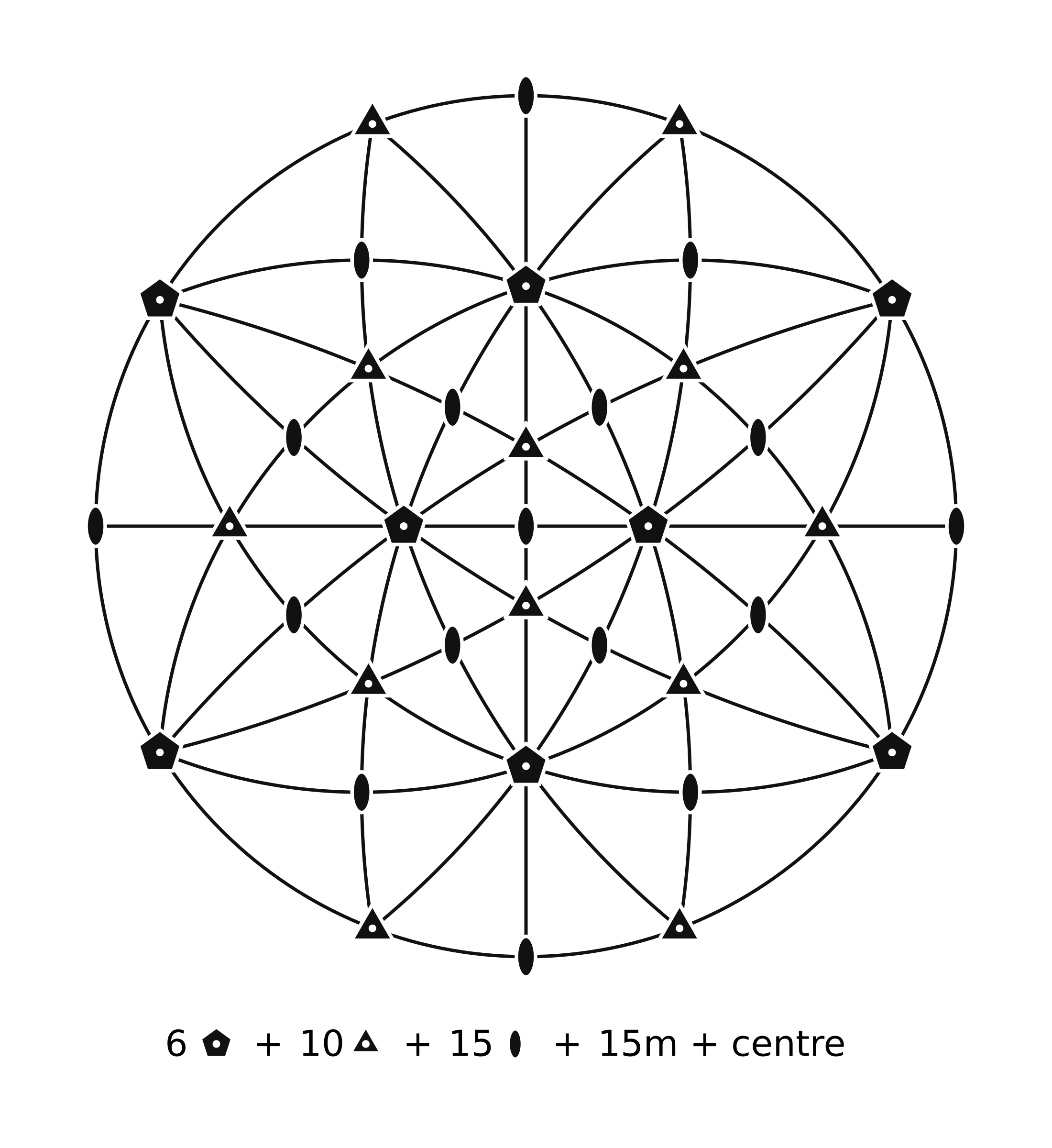
This diagram is a compact representation of the 120 ways to apply symmetry operations in the icosahedral symmetry group. I used to make T-shirts with these diagrams. Symmetry is so cool.
Anyway, I got interested in symmetry when there was a wave of interest in equivariant neural networks. The most famous equivariant neural network is AlphaFold2. Ironically, the AlphaFold2 paper showed that equivariance barely mattered for accuracy. The real innovators of equivariance were Taco Cohen, Michael Bronstein, Tess Smidt, Max Welling, Mario Geiger, Maurice Weiler, Risi Kondor, and the many others focused on geometric deep learning in point clouds. That was truly hard math, cutting edge algorithms, and kind of a mess because so much was changing so fast. Much of my own textbook is focused on organizing deep learning methods based on the symmetry they preserve.1
I'm digressing. The point is, symmetry became a requirement for deep learning and I spent a lot of time on it.
My academic training was in molecular dynamics. In molecular dynamics, you run simulations that hold some variables constant (like the number of particles in the simulation). Usually, the variables are familiar, like temperature or pressure. While I was steeped in symmetry in 2022, I had this idea of keeping the symmetry group of molecular dynamics simulations constrained. It's a weird idea compared to temperature. But it was a fun math problem. I tinkered with it for a while, and my student, Sam, was able to help come up with applications for this idea.2
I wrote a simulation engine in C that had all the math for 2D and 3D space groups built in. The visuals for the resulting paper were mesmerizing. For example, the overview figure for the paper looks captivating:
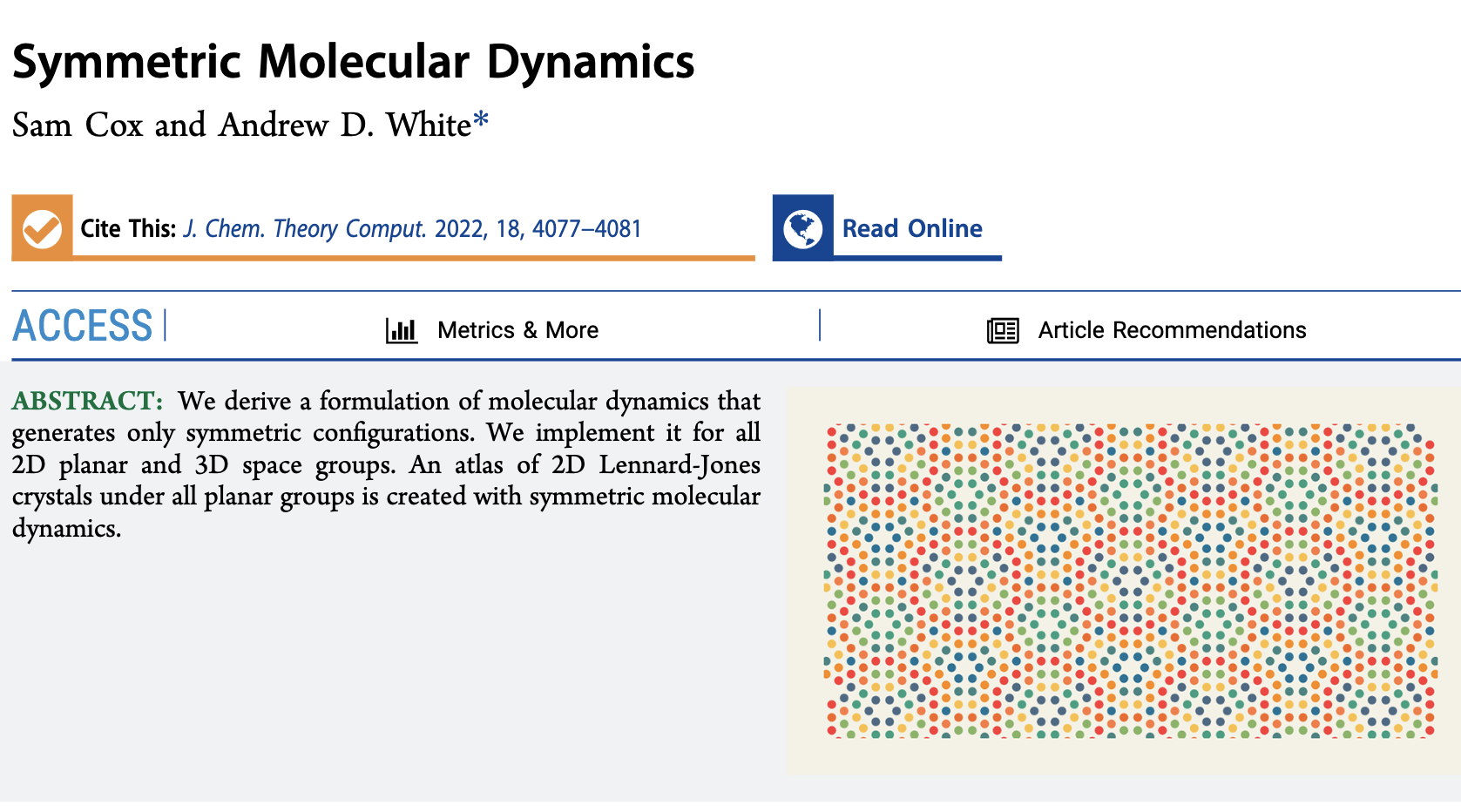
One funny thing about the universe is that there is a finite number of ways to fill an unbounded volume with a repeating pattern3. In 2D, these are called the "wallpaper groups," and there are 17. In 3D, there are the 230 "space groups." So I had this idea of creating an atlas of all these groups and making it dynamic, so you can watch the particles move according to each tiling. We implemented the math and mechanics in the paper, but it was not practical for people to see. I tried a YouTube video, but it wasn't quite a self-serve atlas.
It's 2026, though! I just pointed Opus-5.5 at my visualization pipeline and the C engine and asked it to implement the simulation as a WebGPU application and make it a nice website. It did an amazing job. Here's the embedded version:
And now you can see the live atlas.4 It's so amazing for me to see it completed because it always seemed like a mountain of work for a side project.
At this point, I would muse about AI or meaning of projects or level of ambition or something. But instead, just look at the beautiful atlas of symmetric molecular dynamics.
Footnotes
-
White, Andrew D. Deep Learning for Molecules and Materials. Living Journal of Computational Molecular Science 3, no. 1 (2021): 1499. doi:10.33011/livecoms.3.1.1499. ↩
-
Cox, Sam, and Andrew D. White. "Symmetric Molecular Dynamics." Journal of Chemical Theory and Computation 18, no. 7 (2022): 4077–4081. ↩
-
I know, there are many caveats like aperiodic tilings and the unbounded number of Wyckoff site/occupancy combinations. Just go with it. ↩
-
White, Andrew D. An Atlas of 2D Crystals. Interactive website. ↩